


Walk the floor of enough tech events, and you learn to appreciate a company willing to swing for the fences. Approaching a transformed version of San Francisco’s historic Palace of Fine Arts last week, it was immediately clear Dreame is serious. The exterior of the century-old building, with its classical architecture, was a sharp contrast to the interior, which was draped in aggressive, space-age branding.
The grandiose presentation felt apropos for a sweeping showcase of products and future-defining strategy, one that rivaled the blank-check press events thrown by the likes of Samsung. Dreame wants the world to know it’s serious about evolving from a household appliance manufacturer into a global technology titan, and it has the foundational engineering, access, and global reach to make a real go of it.
The core theme of the show is what Dreame calls a unified “human-car-home” ecosystem, which rests heavily on the premise that it already knows how to automate your home, and now it wants to integrate that with all other areas of your life.
There was plenty to take in, and we’ll get into all of it before long, but the undisputed stars of the showcase were a pair of electric vehicles, including one powered by rockets.
Starting with the base model, the Dreame Nebula Next 01 (the green speed demon we saw earlier this year at CES), is a stunner. It’s a quad-motor, 1,876-horsepower electric hypercar with a high-dollar aesthetic. In fact, it’s almost too familiar; the silhouette is something out of Bugatti’s playbook.
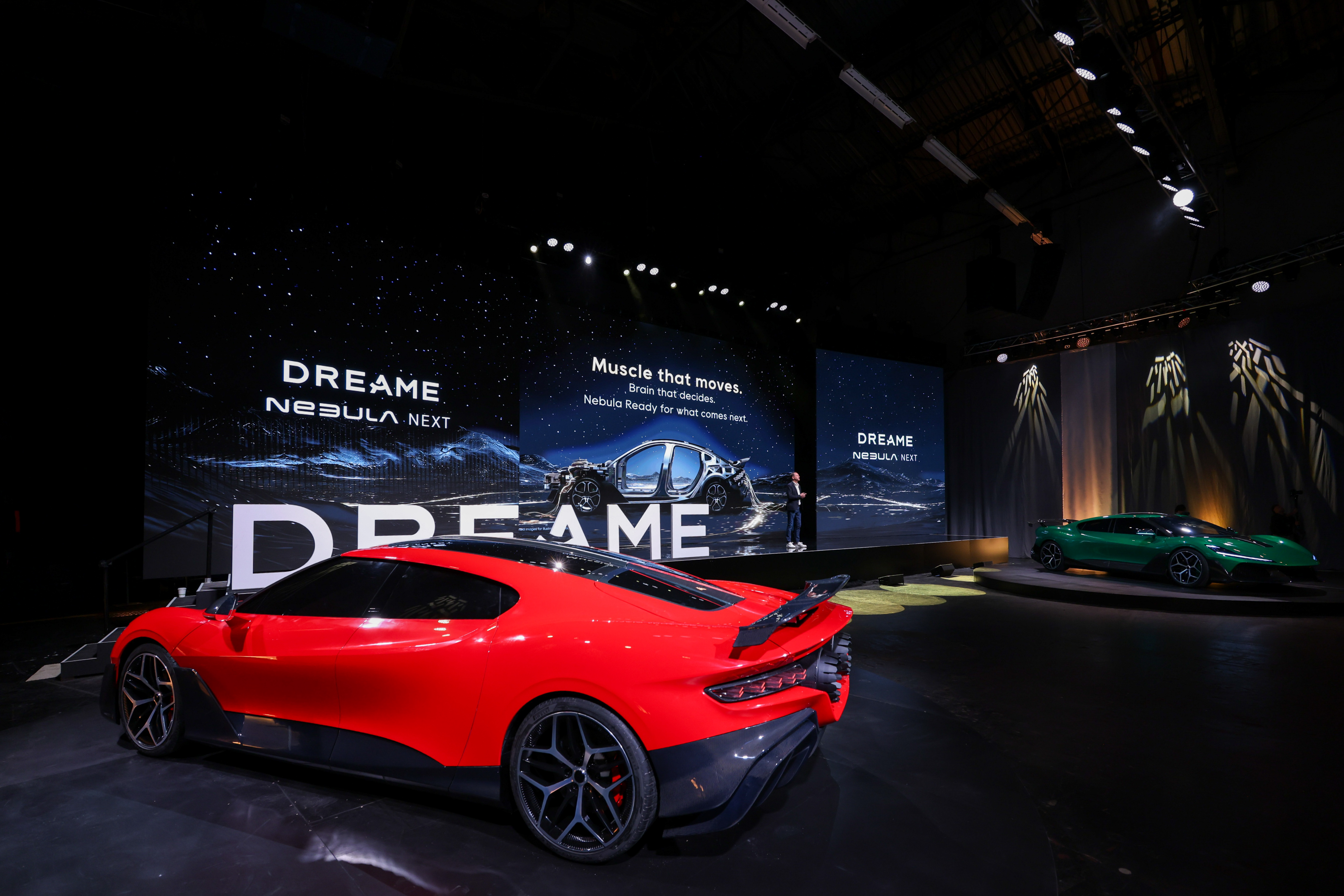
The cars are said to run on improved sulfide-based solid-state battery tech, featuring a 60Ah block with a single-cell energy density of 450Wh/kg — no idea what kind of range that will net. The company claims to have nearly eliminated battery safety concerns through its engineering.
They’ll also use local “proactive” AI models with multiple subagents, ushering in a new paradigm coined “AI-defined vehicles.” Dreame says the system is designed not only to help you operate the vehicle, but also to autonomously monitor each major vehicle system, process real-time data, learn and adapt from driving sessions over time, and control its mechanics with superhuman nuance. That includes the ability to perceive and respond dynamically to weather and road conditions with its 4K-capable DHX1 6D full-color lidar (a world first) and pinpoint the location and distance of sounds, such as emergency vehicle sirens.
The AI agent controlling all of this, named “Metis,” can also be a “co-evolving emotional companion” with “hyper-personalized memory.” Not sure I want to leave that to an AI, but I digress. It’s a locally run edge model that can also communicate with other devices, such as the robotic Dreame appliances and gadgets you can buy for your smart home.
Imagine setting your GPS to home and having your robotic vacuums and washing machines (or, inevitably, your humanoid helper) automatically tidy everything by the time you arrive. Your smart thermostat kicks the HVAC system into gear to get your home to an ideal temperature. Your garage doors open and front doors unlock as soon as you pull into the driveway, no buttons required.
Much of this is possible now with an amalgamation of tech from different companies, plus a little elbow grease required on your part to link and automate it all. But Dreame has a holistic vision to seamlessly integrate everything under one virtual puppeteer, an undertaking that sounds monumental.
In determining whether there’s a realistic path to global success for the Chinese upstart, it’s worth critically assessing the viability of its plans to launch an out-of-this-world rocket-powered electric vehicle as the centerpiece.
Dreame’s jet: prepared for takeoff or grounded in reality?
Dreame had new surprises to share at the show, introducing the Nebula Next 01 “Jet Edition,” which supposedly straps a 100 kN solid-fuel rocket booster to the rear, claiming a blistering 0-62 sprint of just 0.9 seconds at its peak power.
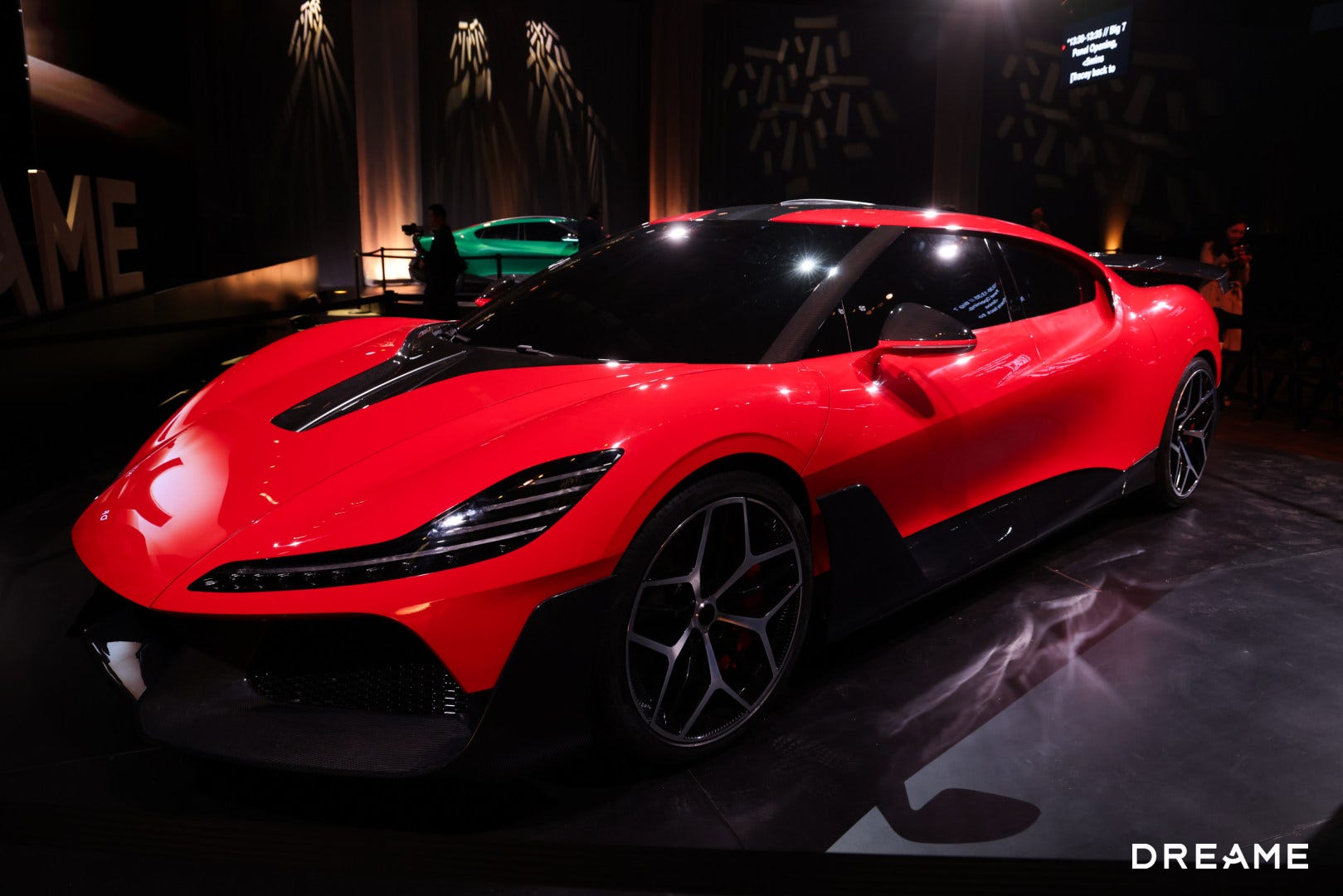
The frame supporting it is a fully wire-controlled robotic chassis with electromagnetic suspension and dry brake-by-wire tech. It’s said to enable a turning radius of less than 5 meters while reducing energy consumption by more than 50%. It supposedly supports advanced maneuvers like tank turns and tire-burst stabilization.
I’m merely a tech journalist, not a physics expert, but I was immediately skeptical of the feat. Why has no other EV maker tried putting a rocket in a consumer-centric car, and what makes Dreame qualified to be the first?
A quick crash course revealed to me that, in safe, stable driving conditions, a car’s acceleration and speed are limited by how much power the engine can transfer to the wheels and how much its tires can grip the road. For most high-performance street tires on dry asphalt, the coefficient of friction sits between 1.0 and 1.2.
This effectively caps non-boosted acceleration at around 1.1g or 1.2g. To hit 62 mph in under a second, you need to sustain an average of about 2.7g of force. (Drag tires can handle much higher acceleration, but not with reasonable sustainability. You’d probably need to replace the tires after a few rips.)
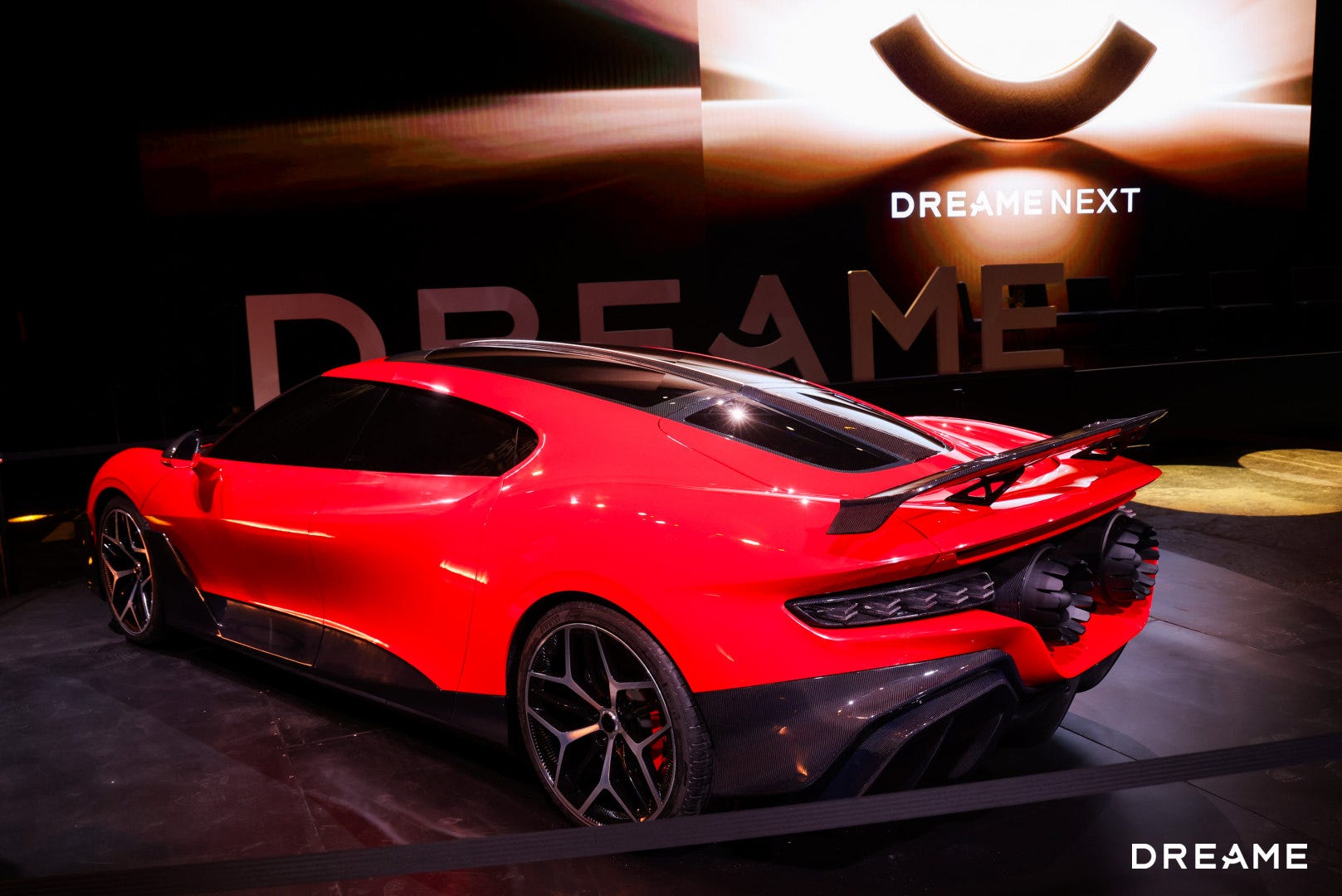
As noted by automotive engineering experts like Jason Fenske of Engineering Explained in his analysis of similar “rocket” claims, once you hit a certain threshold, the only way to go faster while keeping the car stable is to pull the car down, either by creating artificial weight using high-powered fans (essentially creating a vacuum effect that pulls it to the ground) or using massive downforce achieved by aggressive aerodynamics. Dreame claims it’s solved the problem mostly with the latter, thanks to an over-engineered body and chassis that can handle sustained driving at these speeds.
But for sheer forward propulsion at those speeds, the tires hardly matter — the rocket power is essentially forcing the car forward at that point, no matter how much torque you have. I don’t know enough about the science to call it either way, but I do know there’s a good reason we don’t see rocket-powered vehicles on the I-35.
Even assuming the engineering works, putting a solid-fuel rocket on a consumer vehicle puts Dreame in a regulatory minefield. To that end, the “Jet Edition” model would likely be dead on arrival in the United States, at least, and it’s hard to believe that’d be different in any other country with serious transportation and safety standards, even on sanctioned race tracks.
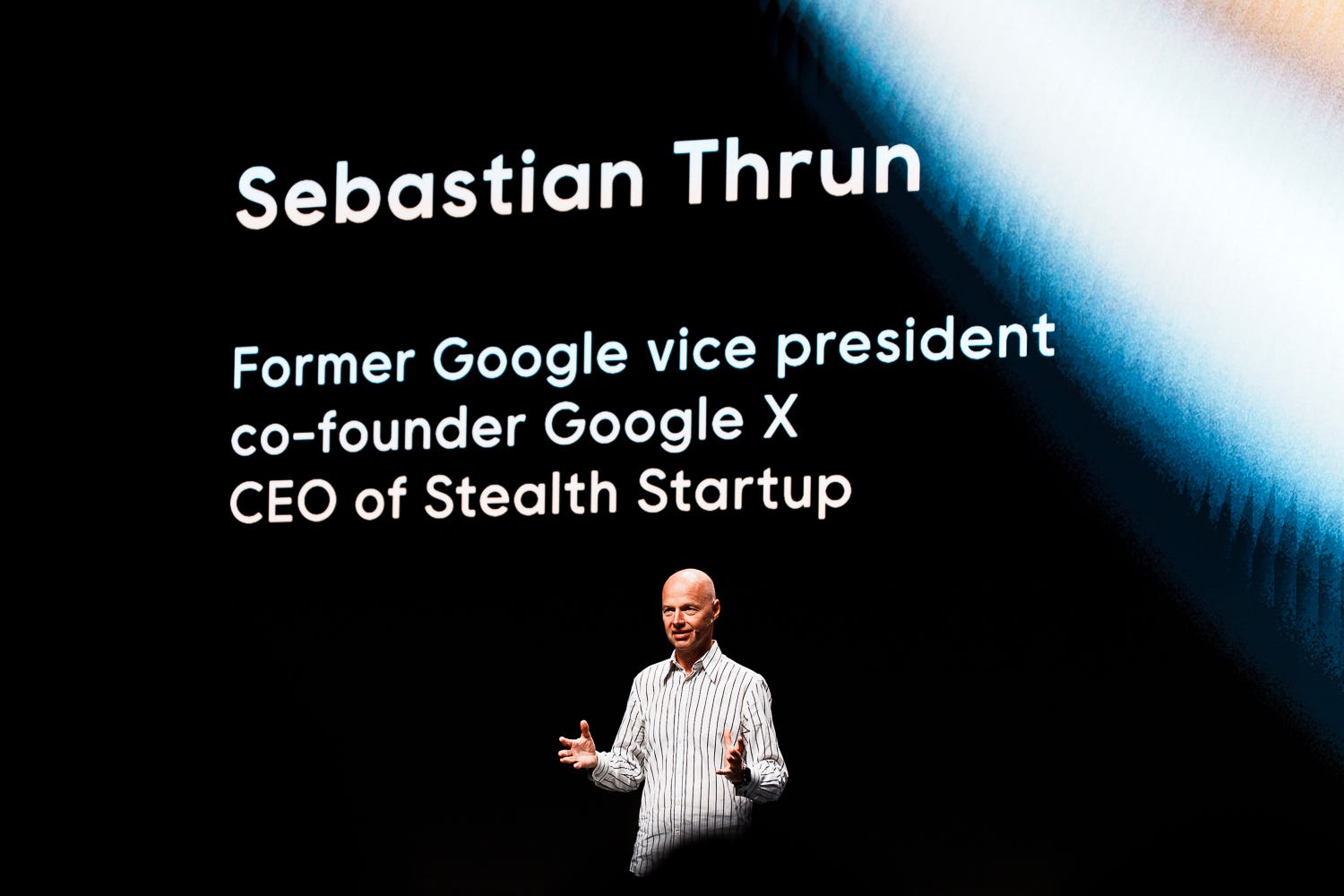
Dreame brought in a serious industry heavyweight as a receipt. Sebastian Thrun, an ex-Googler who helped pioneer Waymo’s original autonomous concepts, appeared onstage to herald it as the most exciting project he’s ever seen. No matter the questionable feasibility of some of these claims, his testimony demands the benefit of the doubt. (And I personally believe he was mostly speaking of the AI and EV tech, not so much the rockets.)
However, I remain an “I’ll believe it when I see it” kind of guy. The car doors on the Palace floor were locked so tightly and the windows tinted so heavily that we still couldn’t look inside. For all anyone knows, these were glorified Hot Wheels cars. (In fact, I’m pretty sure the thrusters on the rear of the Jet Edition were unvented plastic or rubber, which rocket exhaust would melt right off.) There is currently no public evidence of road testing, leaving the gap between a locked concept car and a rocket-powered reality incredibly wide.
I sat down with Dreame Auto’s CMO for a brief chat at the company’s UC Berkeley presentation a week earlier. When asked about the wildly accelerated 2027 target to get the base Nebula Next 01 EV on the road, he suggested that building these cars wasn’t hard, which is a brow-raiser from a company that’s never successfully built one. He’s right in the sense that the blueprint for the fundamentals of building electric vehicles has long been established, and that might be true for a souped-up Tesla posing as a Bugatti, but not for a road rocket.
To be fair, I believe he was being intentionally coy and tight-lipped ahead of the Jet Edition reveal. As for the basics, he cited Dreame’s advantageous position in China, where it has a beat on production and material pipelines that are constantly growing and evolving to support the mass production of EVs, especially with homegrown talent like Xiaomi entering the space.
But that’s still a remarkably casual stance for a company that’s never built one, claiming to shatter technological and legal barriers that legacy automakers haven’t even figured out yet. Building a car is hard, especially an L3/L4 autonomous vehicle. And for one of those cars, it quite literally is rocket science.
How the rest of the “people-car-home” system factors in
Smart home hardware is where Dreame can actually flex some tangible muscle. It showed off its robotic pool cleaners and mowers, the latter now sporting a robotic arm that can help tidy the grass and do other lawn work, plus an updated version of its more traditional mower.
Dreame also had TVs with automatic rotating external speakers that can use AI to optimize the sound specifically for your home, smart locks, washers and dryers compatible with an external robot that can sort and move your clothes between the laundry receptacles, and even a smart fridge with an articulating arm that can put your groceries away.
Injecting AI and robotics into a product sparks instant intrigue, even if it’s starting to feel like a predictable parlor trick for contemporary tech brands. But I always question whether some of these devices actually need it. In some cases, it feels like not even Dreame knows.
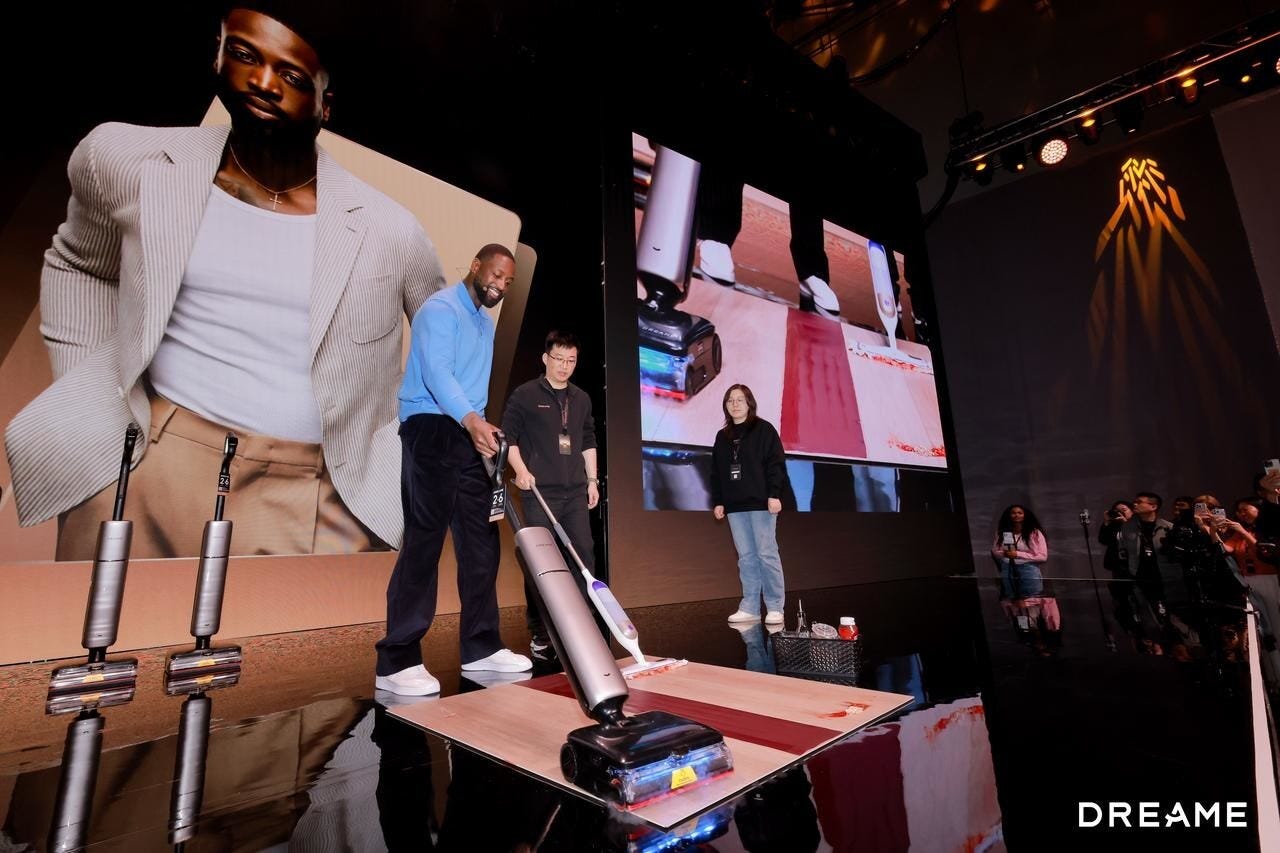
Case in point: the flagship Aero Ultra Steam stick vacuum — demoed by former NBA star Dwayne Wade at the show — is a wet-dry model that can use steam, hot water, and foam all in one. That sounds useful on its own, but one of the Dreame representatives on the show floor told me it uses AI, yet couldn’t explain exactly how or why.
Over in the personal care booths, we saw attendees demoing the brand’s AI-powered hair dryer and straightener, the Aero Straight Pro. It detects your hair type and its current state to prescribe the perfect settings, but one of the ladies seemed stumped on whether it’s doing anything a regular old Dyson wouldn’t.
It’s hard not to question whether consumers actually need AI’s help in front of the vanity, or whether Dreame is just terrified of shipping a product in 2026 without an AI sticker slapped on the box like everyone else.
Dreame is getting into mobiles and wearables, too
The smartphones similarly relied on an abundance of style to mask a lack of substance, which is alarming, considering it’s supposed to be one of the main enablers in Dreame’s vision. The Aurora Lux series — phones dripping in gold plating and encrusted jewels — look just as rich (and expensive) as advertised.
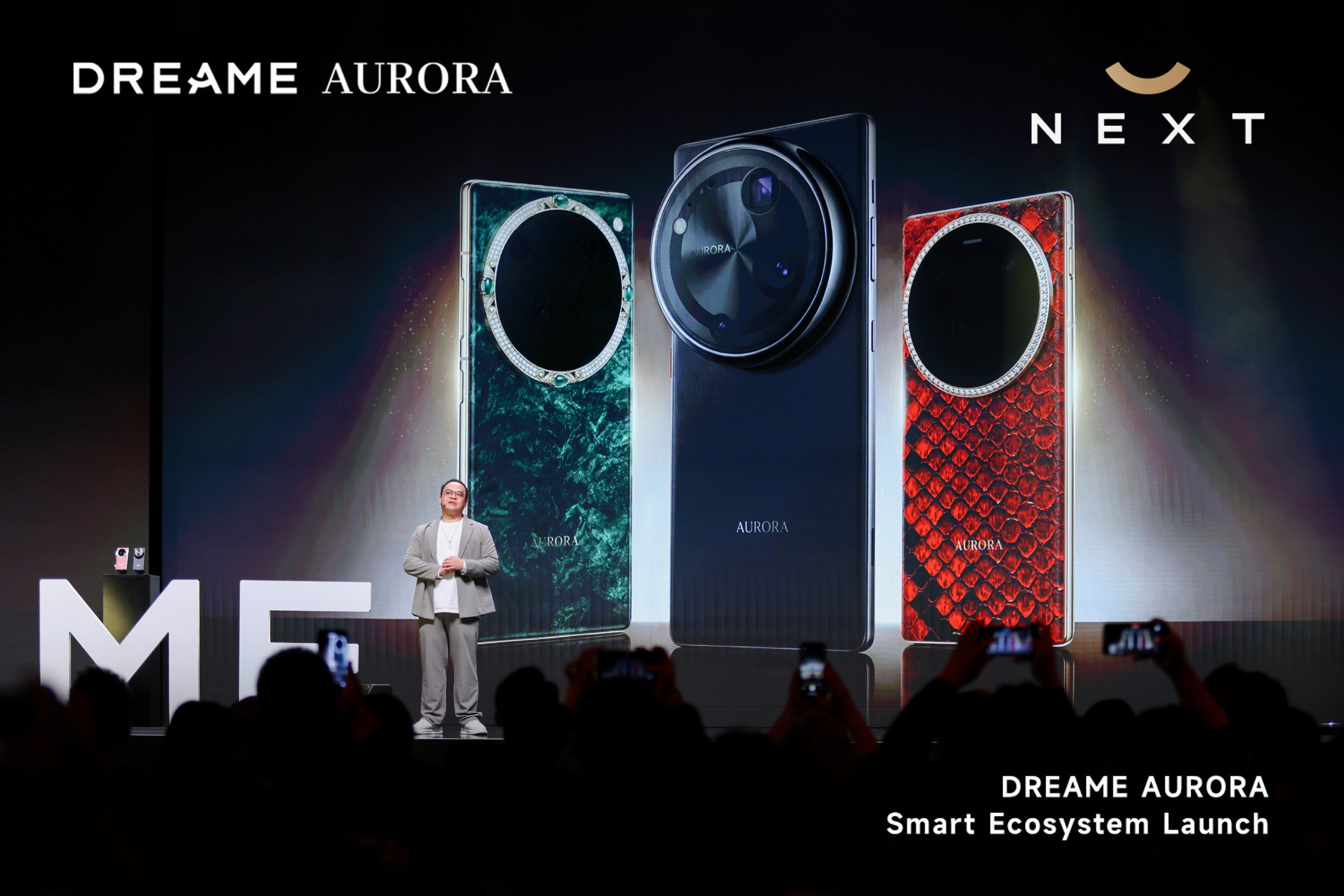
Dreame claimed to be working on nearly 30 models in this line alone, a staggering number that raises red flags given its youth in this arena. To be fair, the company does have a direct link to Xiaomi, a tech giant in its own right that’s made waves outside of North America, so a sharp pivot into mobile hardware isn’t entirely out of the question. At this scale, however? I’m doubtful it can start with more than just a couple.
What I demoed feels less like a production-ready product line and more like a conceptual showcase. I wouldn’t be surprised if the rear design is the main differentiator among them. Despite the absurd opulence and the expectation that these devices will serve as the command center of your entire life, the so-called “AIOS” operating system felt woefully underequipped. It appears to be just an Android skin with basic enhancements right now.
The company also had the Nex LS1, a modular smartphone with several interchangeable attachments, behind glass. It’s sporting a 1-inch 200-megapixel main sensor and a 115mm-equivalent periscope lens. Some attachments offer alternative camera options, while others can add extra capabilities such as satellite communication.
Elsewhere, Dreame showcased a line of smart glasses from its eyewear partner Moonix, pitched as a direct rival to Meta’s Ray-Bans with claims of 16-hour battery life and superior video quality. They’re incredibly light and pass for stylish, with a wide range of more than 100 styles expected. That’s far more than any other brand.
Admittedly, the glasses seemed unremarkable on the surface, but Moonix is teasing a full suite of AI features, including the ability to take notes and organize them into slides, as well as automatically edit your clips into a social-ready video. I couldn’t try the units on display as they were non-functional.
Ditto for the VitalGuard 1 (an Apple Watch lookalike) and stylish smart rings, which will be available in premium metals and jewels, with haptics and standard wellness-tracking features. Another ring it showcased uses NFC to unlock doors.
All in all, it feels like yet another ambitious but underbaked product family waiting for a cohesive identity.
Can Dreame break out as a global megabrand?
Dreame’s ambitions clearly go far beyond the smart home. It wants to be in your driveway, in your pocket, and in every other part of your life, shedding its primary identity as a home robotics company to become one you can build your entire life around.
It expects to be recognized as a major player, standing shoulder-to-shoulder with tech giants like Tesla, Samsung, and Sony. To that end, the decision to hold a grand showcase in San Francisco, the epicenter of Western tech, was a deliberate flex.
Does Dreame already deserve recognition in such prestigious company? The engineering chops are undeniable, but getting there is a lot more complicated than merely knowing how to build all the things. It can claim some retail competence, at least — between its own stores and an endless number of partner retailers, you can find its products in over 120 countries.
Historically, Chinese consumer tech brands have faced a steep uphill battle in the US. Launching one-off products or a small family of them is one thing. Attempting to launch a hyper-connected, AI-driven vehicle, smart home, and mobile communication ecosystem — where user data, cameras, and connectivity are heavily scrutinized — under an administration that remains openly hostile toward China’s ruthless tech expansion is going to be a brutal regulatory and marketing gauntlet.
Ultimately, I walked away from the Palace of Fine Arts with cautious optimism that, perhaps outside its real-world Batmobile, Dreame isn’t just peddling pure vaporware. Its growing smart home lineup demonstrates impressive manufacturing capabilities, but can it do so at a massive global scale across so many genres concurrently?
The foundational pieces of this grand puzzle actually exist, and I don’t doubt that, given enough time and resources, Dreame can eventually put it all together. But right now, the chasm between a locked concept car and a road-ready rocket at the center of a whole-life tech ecosystem feels vast.