


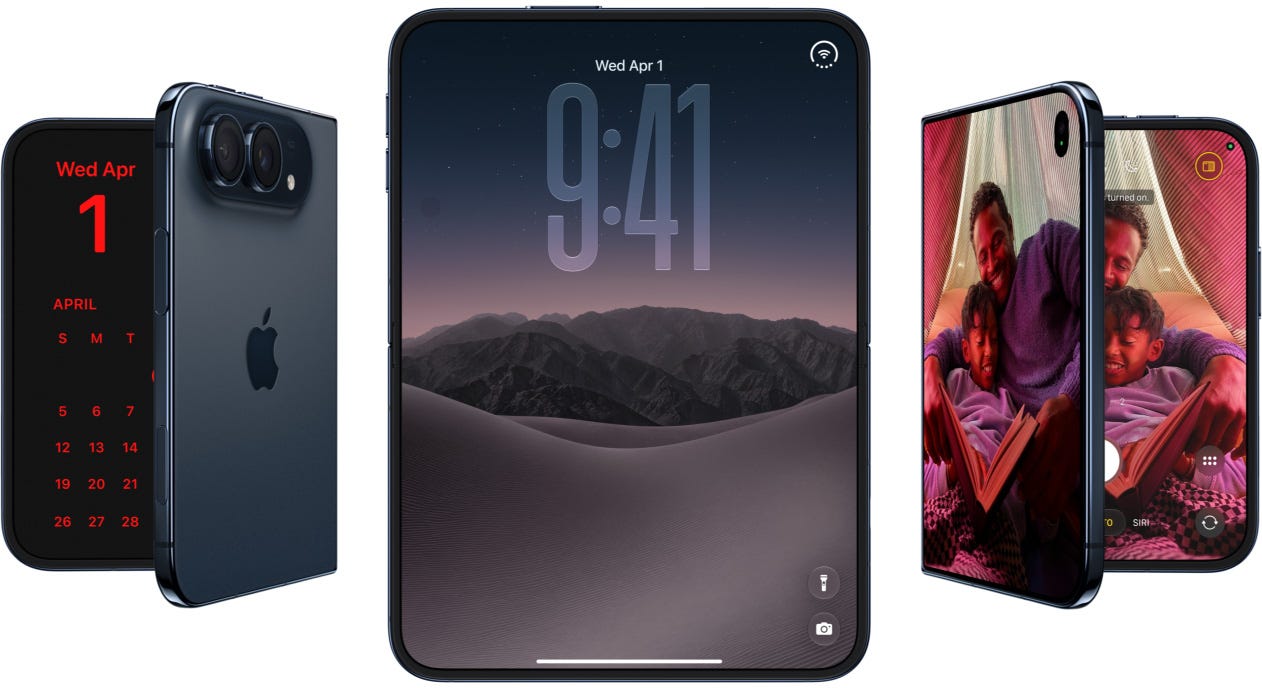
Alongside a routine update to the mainline iPhone family with the iPhone 18, Apple has finally entered the foldable hardware space by introducing the iPhone Duo. It’s the company’s first take on the form factor: a $2,000 passport-style device with a smaller outer screen but unfolds to reveal a 7.6-inch tablet-sized internal display (the biggest on any iPhone to date). Powered by the A20 Pro processor, the iPhone Duo effectively shrinks an iPad mini’s active screen real estate into a pocketable footprint.
The book-style device pairs a 5.4-inch OLED cover screen on the exterior with the larger 7.6-inch interior panel, both with 3,000-nit brightness, 120Hz ProMotion, and sharing the same aspect ratio. The inner display features a scratch-resistant nano-texture coating and, later this year, will support Apple Pencil.
Under the hood, the A20 Pro chip sits alongside Apple’s in-house C2 modem. Rather than adapting Face ID sensors to the thinner folding display, Apple embedded Touch ID directly into the side power button. For optics, the Duo features a dual 48MP rear camera array with fixed-aperture sensors (one ultra-wide-angle and one standard lens for up to 2X optical zoom) paired with a 12MP front sensor. Another front-facing camera hides beneath the inner display, though it lacks Face ID (Apple has integrated Touch ID into the power button for biometric authentication).
The iPhone Duo sounds decently durable, with a chassis carrying an IP68 dust- and water-resistance rating backed by a carbon fiber and titanium hinge assembly, plus Ceramic Shield and Ceramic Shield 2 offering scratch and shatter resistance. Early reports suggest the display has a slight crease when unfolded, but it’s far less perceptible than on competitors.
Seamless mode-switching and app continuity when moving from the outer screen to the inner screen is a key edge Apple will look to hone and set the Duo apart. Samsung and others have struggled to polish that aspect of their respective foldable experiences, even eight generations in.
Early software demos on the iPhone Duo already show fluid transitions and dynamic user interfaces that change based on the screen you’re using and the device's orientation. For example, Netflix sports a scroll-first UI that makes for comfortable one-handed browsing on the outer display, but expands into a more traditional tablet-like interface when you open the Duo. And if you’re watching something on the outer display, it seamlessly continues playback uninterrupted on the inner display while you’re still unfolding it.
We’re not expecting such tight integration from all apps from the start, but Apple has historically enticed early adoption of new software and hardware features among developers, even with an expectedly small user base.
Apple is encroaching on a product category Samsung has spent over half a decade refining before others started trickling in. While devices like the Galaxy Z Fold and Google Pixel Fold initially struggled with thick profiles and fragile display layers, recent advancements from other industry players have trended toward thinner profiles, minimized hinge creases, and improved durability.
The iPhone Duo matches those hardware benchmarks right out of the gate, and although it wasn’t the first passport-style smartphone, its impending arrival has undoubtedly fueled a sudden wave of foldables using the shape.
Pricing remains a major hurdle for mainstream adoption for any foldable smartphone. Can Apple move the needle with the iPhone Duo? At a $2,000 starting price for 256GB of storage—scaling up to $3,000 for top storage capacities—it’s hitting the market as the most expensive option to date, but Apple is betting on its reputation of "getting it right” to justify the premium.
iPhone Duo will be available starting October 23rd, with preorders opening October 16th. You’ll be able to buy it in Night Sky and Star White, with matching folio-style cases with built-in kickstands, plus slim cases that integrate MagSafe for wireless charging and magnetic accessories.